

sign in |
register |
support |
contact us |
view cart
bhakti yoga
art of living
spirituality
mind
meditation
yoga pranayama
tantra
creativity
enlightenment
sages mystics
shakti
truth
god
youth shivir
sufism
bhajans
kirtan
shabad
discourses on sex
emotions
health
mantra
education
master
feedback
involution
gurbani
lord shiva videos
kabir vani
lord krishna videos
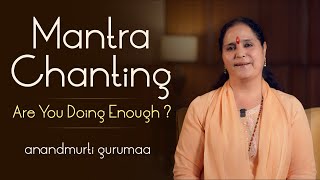
What is mantra chanting and right way to chant? Part 2
Q: Meditation and chanting – between these two practices – which one is more important? Which practice will lead us to liberation? At some places, it is said that if one chants more than 16 rosaries, the soul gets food. And that Do not keep physical relations with other’s husbands and wives, do not eat non-vegetarian food, do not eat onion and garlic, chant 16 rosaries. Is it necessary to follow these four rules? It is said that if a man follows these rules, will he go to Shri Krishna’s abode? And then get liberated from the cycle of birth and death?
A: Meditation and chanting – there is a lot of difference between the two. Chanting means to repeat a certain mantra, for example, this person has written the Mahamantra, “Hare Rama Hare Rama, Rama Rama Hare Hare, Hare Krishna Hare Krishna, Krishna Krishna Hare Hare”. Repetition of this mantra when done softly is called upanshu japa. Upanshu means whispering the mantra, very gently and in a soft voice. The second is when you do the mental or maansik japa without moving the lips or the tongue, you just keep repeating the mantras mentally. It is said that it is better to do the mantra with the breath rather than audibly. Compared to chanting the mantra with the breath, the maansik or mental japa is still better. Kabir Saheb, Guru Nanak Dev and Raidasji did not advise the audible japa. They have rather condemned it.
‘The rosary spins in the hand, the tongue spins in the mouth, the mind spins in four directions’. If this is the state of the mind, then this is not the right way to remember God. Real sumiran happens only when it is being done with full consciousness. When your heart and mind is completely immersed in the mantra, we can say that the person is in Naamsmaran.
Many katha vachaks or orators say that it does not make any difference if the mind is moving in the outside world, still keep on moving the rosary beads in your hand, for this act will shower divine grace or punya on you and God will be pleased. You can do it in any style, any emotion. If a mother calls her child or a wife calls her husband, they will hear her. The husband will not say that you did not call me mindfully. If the child calls its mother, she comes running. It makes no difference to her whether the child has sung her name in a certain raga or not.
But my opinion is that the way you behave in worldly relationships, how can you behave the same way in spirituality? It’s a very illogical logic. I cannot understand this because all the scriptures, all the sayings of the saints whether it be Tukaram or Eknath, they have all said the same thing that remember the Lord with emotion. It should be from the mind. Lord Krishna said a very beautiful thing in the Geeta that one who mindfully or concentratedly remembers me, I dwell in that being’s heart. Krishna has not said this even once that he will be friendly with only those who remember with their tongue. Krishna is a lover of emotion, not of words. This gets well demonstrated in the incident when Duryodhana invites Krishna to his house for dinner and on the same day Vidur also happens to invites Krishna for dinner. Where did Krishna have his dinner that day – at Duryodhana’s palace? Duryodhana is a prince, the invitation is from the palace, and still Krishna turns it down. And where does he go? He goes to Vidur. Why? Because even though the food is being offered at the palace at Vidur’s house, but the emotion with which the food is being offered are of utmost importance to Krishna. So Krishna turns down Duryodhana’s invitation and goes to Vidur’s house inspite of the fact that Vidur is not a Minister of State any more. He had resigned from the official position. Here, Krishna does not say, “I have invitations from two places; I can go to any of the two places”.
And the truth is that Duryodhana had invited Krishna with lot of fervor. He had insisted that Krishna must come, keeping the sword of persistence. However, Vidur had invited Krishna just once. Please take Prasad (food offered to God) at my house. There is no insistence, no greed, no threat and no attraction. As mentioned, Vidur is not a minister of state any more, he is just a common man. And Krishna is hungry for emotion, so goes to his house.
Krishna is not a lover of words. If I look at Shri Krishna’s life play, I come to the conclusion that that the one who loves Krishna cannot say that I will take Krishna’s name without emotion and that Krishna will still be pleased with him and he will receive the bliss or attainment of Krishna.
“Govind is hungry for the bhava or emotion of a bhakta or devotee” – bhajan.
So in my opinion, if you are not doing the chanting with emotion, there is no chanting as such. My beloved ones, even you do not go for mere words, then how can the Lord?
So, what is Naam Smaran, must be understood first. The meaning of Naam Smaran is that when your mind and emotions are totally connected with the vibrations of the word. Now, what does the mantra chanting do? Most of the people think that it is some religious exercise which should be done. You will be amazed to know that many spiritual practices are being researched by scientists; and when the results have come in, its revealed that our saints were talking about Mantra Japa or other spiritual practice, not just from the point of view of pleasing God. Conclusive data about these things is available which has emerged after a lot of analysis and research testing. The truth or the evidence that has come out is that each word in the mantra has a wave or vibration and that each of these waves and vibrations affect your brain. When you pronounce any mantra in a concentrated way, the tarang or sound wave created by it will bring some change or alteration in your brain. It activates the neurons of your brain. The neurons get a fresh lease of energy which means that when you are doing the mantra japa, it has no relation with the fact that God or the Guru will be pleased, but the chanting of the mantra awakens the sleeping parts of your brain.
Our rishis and sages understood this very deeply and that is why they made it mandatory that as soon as a child starts speaking, the first word it should speak is ‘Om’. When the child advances a bit more, it should be taught the ‘Gayatri Mantra’. Even today, some people think this way and believe that this is some religious mumbo jumbo and we are not part of it. But a Research Centre in Australia conducted a research on the words ‘Om’ and ‘Gayatri’ and as per their experiment, the alpha waves will begin to get created in your brain at the time when the word ‘Om’ is being chanted. The alpha waves will start getting awakened in your brain. Now, what are alpha waves? It is an indication that your brain is becoming active. Approximately 94% of our brain is inactive. We are not using 94% of our brains. A very large part of the brain is in slumber, is asleep. At this point, when I am speaking these alphabets, the waves or sounds that are being generated, don’t you think it is affecting you?
See, at times you laugh, at times you ponder, sometimes you become serious, you become sad or you become happy. All these waves produce different kinds of emotions in you. After hearing some talk, one becomes pained or at some talk, one feels like dancing. So, like the effect of the word on your mind, the waves produced by the mantras also affect your brain. Specially, when you chant ‘Om’, your frontal brain gets activated and if the chanting is done in the right way, the effect can reach all the way to your pineal gland. These are doctrines which have been documented. This is the reason why our saints and rishis emphasized the importance of mantra japa right from the Vedic age itself. But people interpret each thing as per their convenience. So they have also interpreted the practice of mantra japa as per their convenience and they rotate the rosary in their hand and even though their mind is thinking of the worldly ways and markets, they are very happy and contented that at least they are doing their japa. But, this is not japa at all.
What does japa mean? You must know when you are speaking. When you are speaking, the tongue touches the upper surface of the mouth, the lower surface, the lips or the jaws. It touches so many places. You have never noted this thing. When you are speaking, your tongue is moving throughout your mouth. Come, let us demonstrate this fact. Hold your tongue. Do it. Now ask me, “Gurumaa, how are you”? You cannot talk if you are holding your tongue. To pronounce a word, the tongue has to move. If someone asks you to speak without moving the tongue, you cannot speak but you will definitely be able to hum. In this case, only the vocal chords will be moving, not the tongue. The tongue has to be used while speaking. So the in-depth explanation of japa is that when you are chanting the mantra, you have to be fully conscious of how your tongue is moving, how your breath is moving and how your mind is moving. So the mind should not be moving and you should be aware of your breath as well as how you are chanting the mantra.
When you are chanting the mantra, you must be fully conscious that you are sitting straight, be fully conscious of your whole body, how you are breathing and what its speed is. If the tongue is moving inside the mouth, what is the movement of the tongue? You should also be aware of the thoughts emanating in your mind. If you do the japa in the right process, there is no chance that your mind will get time to think of something else. When you are not doing the japa with the proper methodology, then your mind keeps thinking of this and that. But when you are doing the mantra japa with the proper method, you receive two very deep effects. Firstly, the neurons of your brain get activated. Secondly, you inwardly get purified. One who is not purified internally, cannot enter meditation.
What is meditation? We can say that when a person is fully conscious, the mind is totally quiet and the body is totally immobile, this is meditation. Some people sit for meditation and very soon, start scratching their head and ears, pick their nose and other parts of their body. Their body is itching all the time and they keep changing their position or keep on looking at their watch. But they go out and tell everyone that they have just completed meditation. What meditation? It never started. So how could you end it? A thing has to start to end, but yours has not started at all, so how can it end? All of you try to understand.
Before you begin meditation or japa, you need to understand what it means to sit in a balanced way. Your body should be balanced when you sit for japa. And here is where Ashtang Yog enters. Just see, just feel your body, how is it sitting? How is your body sitting, please feel it. I say that if a person’s body cannot sit still, how can the mind sit still? Our body is gross, in front of us, if this is not in our control, if we cannot make it sit straight in a methodical way, how can we expect the mind to be under our control? Many people do not know how to even sit straight.